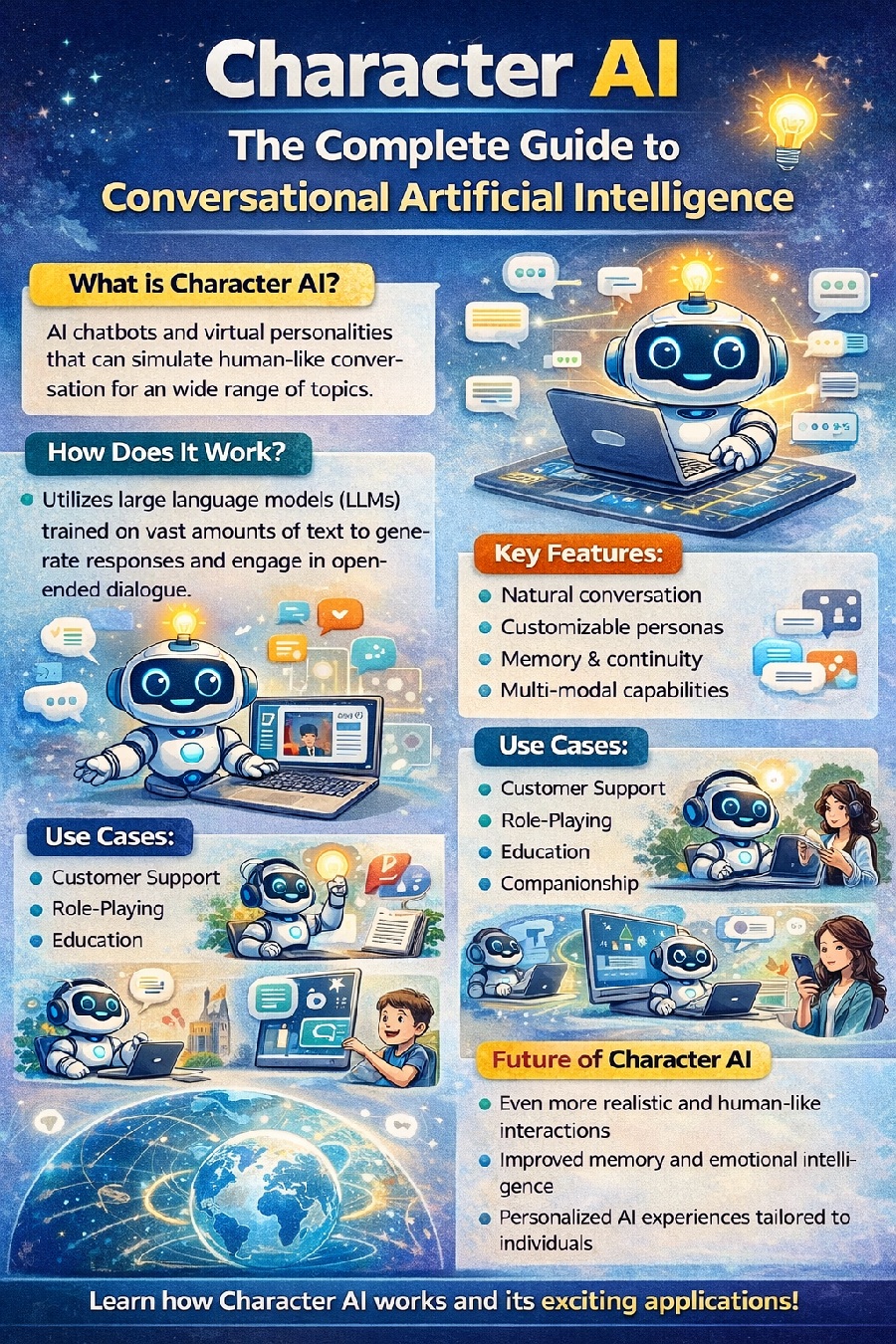
Character AI
Introduction to Character AI
Character AI is rapidly transforming the way humans interact with artificial intelligence. Unlike traditional chatbots that focus mainly on task completion or customer support, Character AI is designed to simulate human-like personalities, emotions, and conversations. It allows users to chat with AI characters that feel alive, expressive, and engaging—almost like talking to a real person.
In recent years, artificial intelligence has moved beyond basic automation into creative and social domains. Character AI represents this shift clearly. Whether users want to talk to a fictional character, create a virtual friend, role-play scenarios, or explore storytelling, Character AI opens up endless possibilities.
Table of Contents
What Is Character AI?
Character AI is a type of conversational AI platform that allows users to interact with AI-powered characters. These characters can have distinct personalities, backgrounds, tones, and conversational styles. Instead of generic responses, Character AI systems aim to maintain consistent character behavior across conversations.
At its core, Character AI uses large language models (LLMs) trained on massive datasets of text. These models are fine-tuned to behave as specific personas. Users can either interact with pre-made characters or design their own characters from scratch.
Popular examples include virtual celebrities, historical figures, fictional heroes, anime characters, mentors, therapists, and even imaginary friends.
History and Evolution of Character AI
The idea of conversational characters is not new. Early chatbots like ELIZA (1960s) and ALICE (1990s) attempted to simulate conversation using rule-based systems. However, these bots lacked depth, memory, and realism.
The evolution of Character AI accelerated with advancements in:
- Natural Language Processing (NLP)
- Deep learning
- Transformer-based models
- Reinforcement learning from human feedback
Modern Character AI platforms emerged in the early 2020s, powered by neural networks capable of generating context-aware and emotionally nuanced responses. This leap made it possible for AI characters to feel more natural, adaptive, and immersive.
How Character AI Works
Character AI systems rely on several advanced technologies working together:
1. Large Language Models (LLMs)
LLMs analyze user input and generate responses based on patterns learned from vast text data. They understand grammar, context, tone, and intent.
2. Character Conditioning
Each AI character is “conditioned” with:
- Personality traits
- Backstory
- Speech style
- Behavioral rules
This ensures consistency. For example, a medieval knight character will speak differently from a modern teenage character.
3. Context Memory
Character AI remembers parts of the conversation to maintain flow and relevance. While memory may be limited, it helps characters respond logically.
4. User Feedback Loops
Many platforms use ratings and feedback to improve responses over time.
Key Features of Character AI
Character AI platforms stand out because of their unique features:
Custom Characters
Users can create their own characters by defining:
- Name and role
- Personality description
- Tone (friendly, sarcastic, serious)
- Example dialogues
Role-Play and Storytelling
Character AI is widely used for role-playing games, interactive stories, and creative writing.
Emotional Intelligence
Advanced Character AI can simulate empathy, humor, excitement, or calmness.
Multi-Genre Characters
From fantasy and sci-fi to romance and education, characters can exist in any genre.
Accessibility
Most Character AI platforms are web-based and easy to use, requiring no coding knowledge.
Popular Use Cases of Character AI
1. Entertainment and Fun
Many users interact with Character AI for casual conversations, humor, or companionship. Talking to favorite fictional characters is a major attraction.
2. Creative Writing
Writers use Character AI to:
- Develop characters
- Test dialogues
- Overcome writer’s block
- Brainstorm story ideas
3. Role-Playing Games (RPGs)
Character AI enhances text-based RPGs by making non-player characters more dynamic and responsive.
4. Learning and Education
Educational characters can act as tutors, language partners, or historical figures explaining concepts.
5. Emotional Support
Some users use Character AI for motivation, stress relief, or journaling conversations, though it is not a replacement for professional help.
6. Marketing and Branding
Businesses experiment with branded AI characters for customer engagement and storytelling.
Benefits of Character AI
Personalized Interaction
Unlike standard chatbots, Character AI adapts to user preferences and conversational style.
Creativity Boost
It helps users explore imagination, storytelling, and role-play in unique ways.
24/7 Availability
AI characters are always available, making them ideal companions or assistants.
Scalable Experience
Millions of users can interact with AI characters simultaneously without performance loss.
Safe Exploration
Users can experiment with ideas, personalities, and scenarios in a controlled environment.
Character AI vs Traditional Chatbots
| Feature | Traditional Chatbots | Character AI |
|---|---|---|
| Personality | Generic | Unique & defined |
| Conversation Style | Task-oriented | Free-flowing |
| Emotional Tone | Limited | Rich & adaptive |
| Use Cases | Support, FAQs | Entertainment, role-play, creativity |
| User Engagement | Short | Long-term |
Character AI focuses more on experience and immersion rather than utility alone.
Limitations of Character AI
Despite its strengths, Character AI has limitations:
Memory Constraints
Most Character AI systems cannot remember long-term details across sessions.
Hallucinations
AI may generate incorrect or fictional information confidently.
Emotional Dependence
Over-reliance on AI companionship can be unhealthy for some users.
Content Restrictions
Platforms often apply strict moderation, which may limit certain role-play scenarios.
Lack of True Understanding
Character AI simulates intelligence but does not truly understand emotions or reality.
Safety and Ethical Considerations
Character AI raises important ethical questions:
Data Privacy
User conversations may be stored for training or moderation. Transparency is crucial.
Age Restrictions
Young users must be protected from inappropriate content or emotional manipulation.
Mental Health Risks
AI should not replace human relationships or professional therapy.
Misuse and Misinformation
AI characters impersonating real people or spreading false information is a concern.
Responsible development and clear usage guidelines are essential.
Character AI in Content Creation and SEO
Character AI is increasingly used by content creators and marketers:
- Generating fictional interviews
- Creating brand mascots
- Interactive storytelling for blogs
- Gamified user engagement
When used ethically, Character AI can enhance user retention and creativity in digital content strategies.
The Future of Character AI
The future of Character AI looks promising and transformative:
Improved Memory
Future systems may remember long-term user preferences and histories.
Multimodal Interaction
Voice, avatars, and video-based characters will become common.
Deeper Emotional Simulation
AI characters may respond more accurately to emotional cues.
Integration with VR and AR
Character AI could power immersive virtual worlds and metaverse experiences.
Personalized AI Companions
Users may have lifelong AI characters that evolve with them.
Is Character AI Safe to Use?
For most users, Character AI is safe when used responsibly. However, users should:
- Avoid sharing sensitive personal information
- Treat AI as a tool, not a human replacement
- Follow platform guidelines
Parents should monitor usage for minors, and platforms should continue improving safeguards.
Conclusion
Character AI represents a new era of human-AI interaction—one that emphasizes personality, creativity, and engagement. From entertainment and storytelling to education and branding, its applications are vast and growing.
While Character AI is not without limitations or ethical challenges, its potential to reshape digital experiences is undeniable. As technology evolves, Character AI is likely to become more immersive, intelligent, and integrated into everyday life.
About the Author